


- Case study
Large-format 3D printing with a robotic arm from recycled pellets
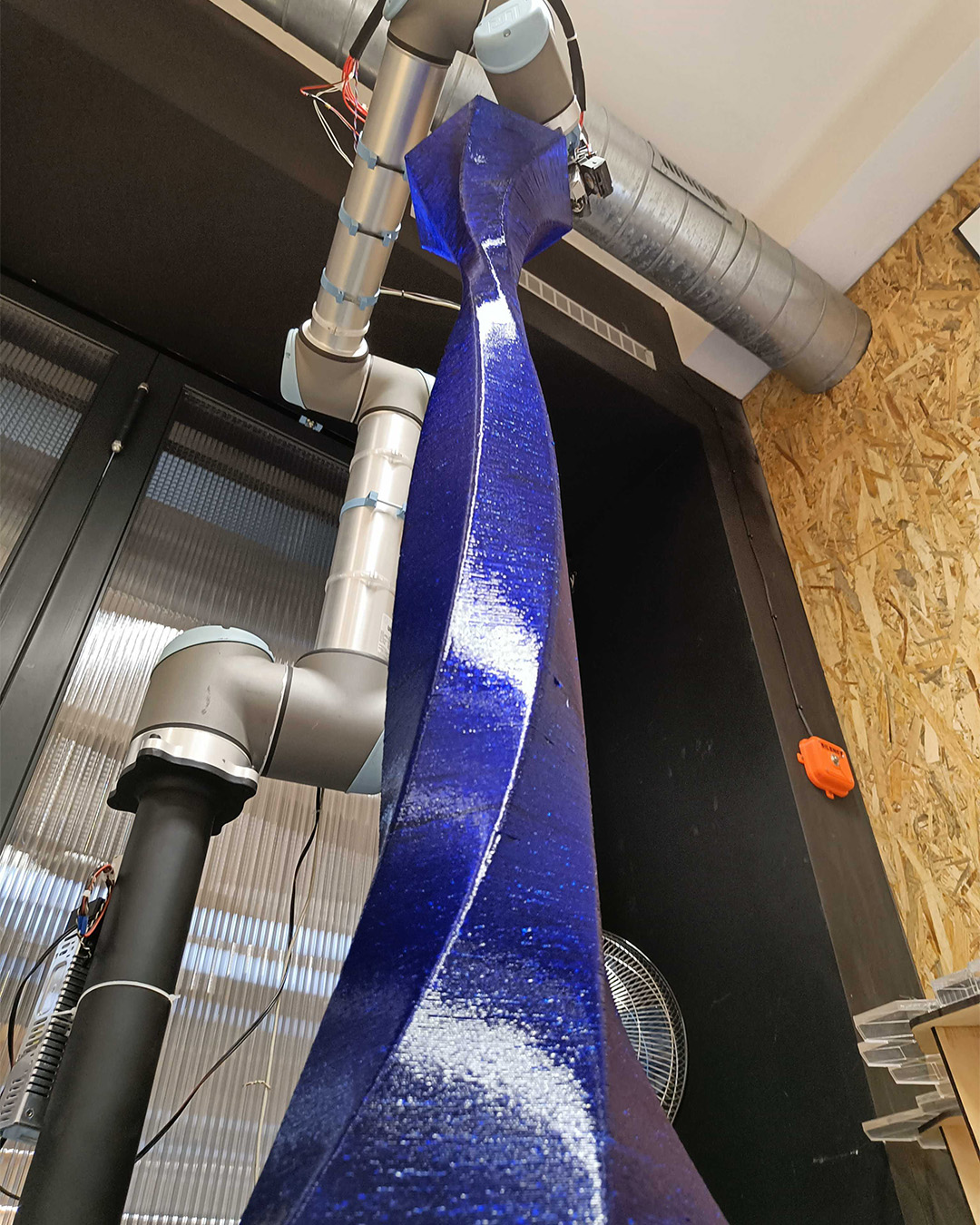
How do you print large objects from plastic that would otherwise end up as waste? At PrusaLab, we fitted a decommissioned Universal Robots UR10 industrial arm with a pellet extruder and taught it to print from recycled Prusament that had failed quality control. After upgrading the extruder, we printed over half a kilogram of material per hour and tested a print two metres tall.
Customer
PrusaLab's own development with architect Petr Vacek
Field
plastic recycling, large-format 3D printing, robotics
Year
2021–2022
Result
extruder output up from 220 g to over 0.5 kg per hour, 2 m tall test print
Plastic that failed quality control
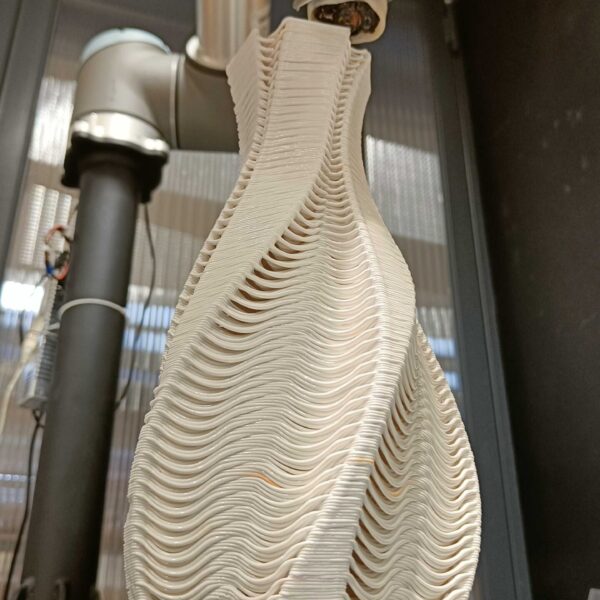
Some Prusament filament doesn't pass strict quality control, and its only other use is being turned back into pellets. We wanted to find out whether such recycled material could be printed directly and at large scale.

A robot instead of a printer
We repaired a decommissioned UR10 collaborative arm and, together with architect Petr Vacek, first taught it to draw on a whiteboard. Then we fitted it with a pellet extruder, turning the robot into a large-format 3D printer.
From 220 grams to half a kilogram
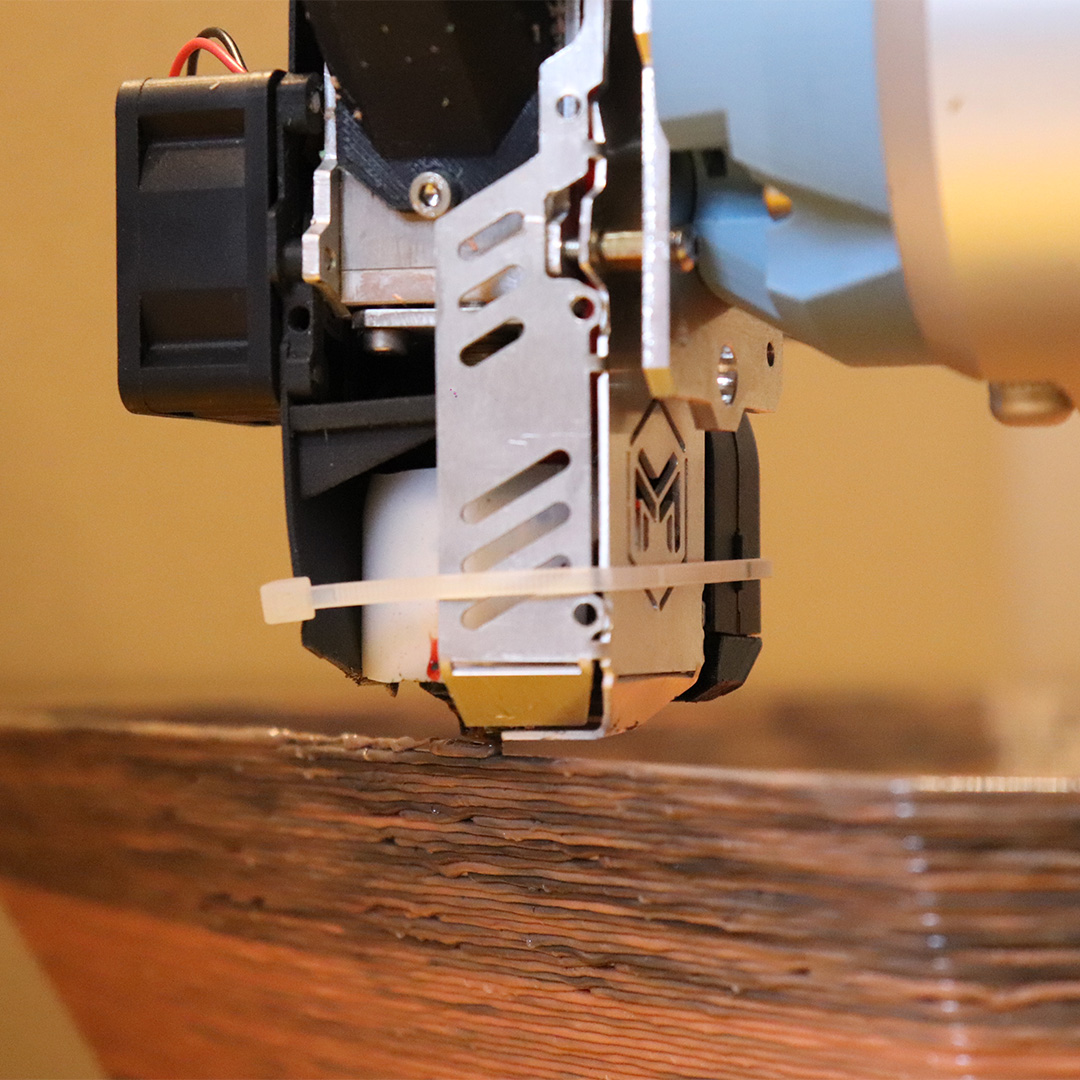
A pellet extruder feeds the granules with a screw and melts them at a higher temperature than a regular printer. With a new motor, cooling, nozzles and heaters, we increased its output from 220 g to more than half a kilogram of material per hour.

Printing beyond flat layers
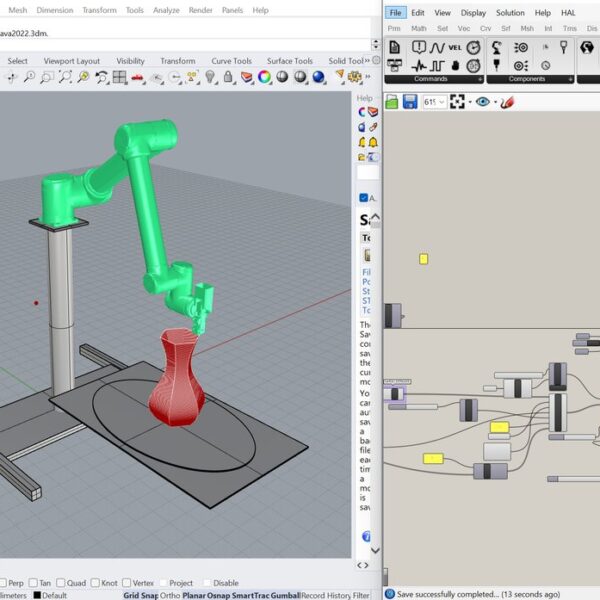
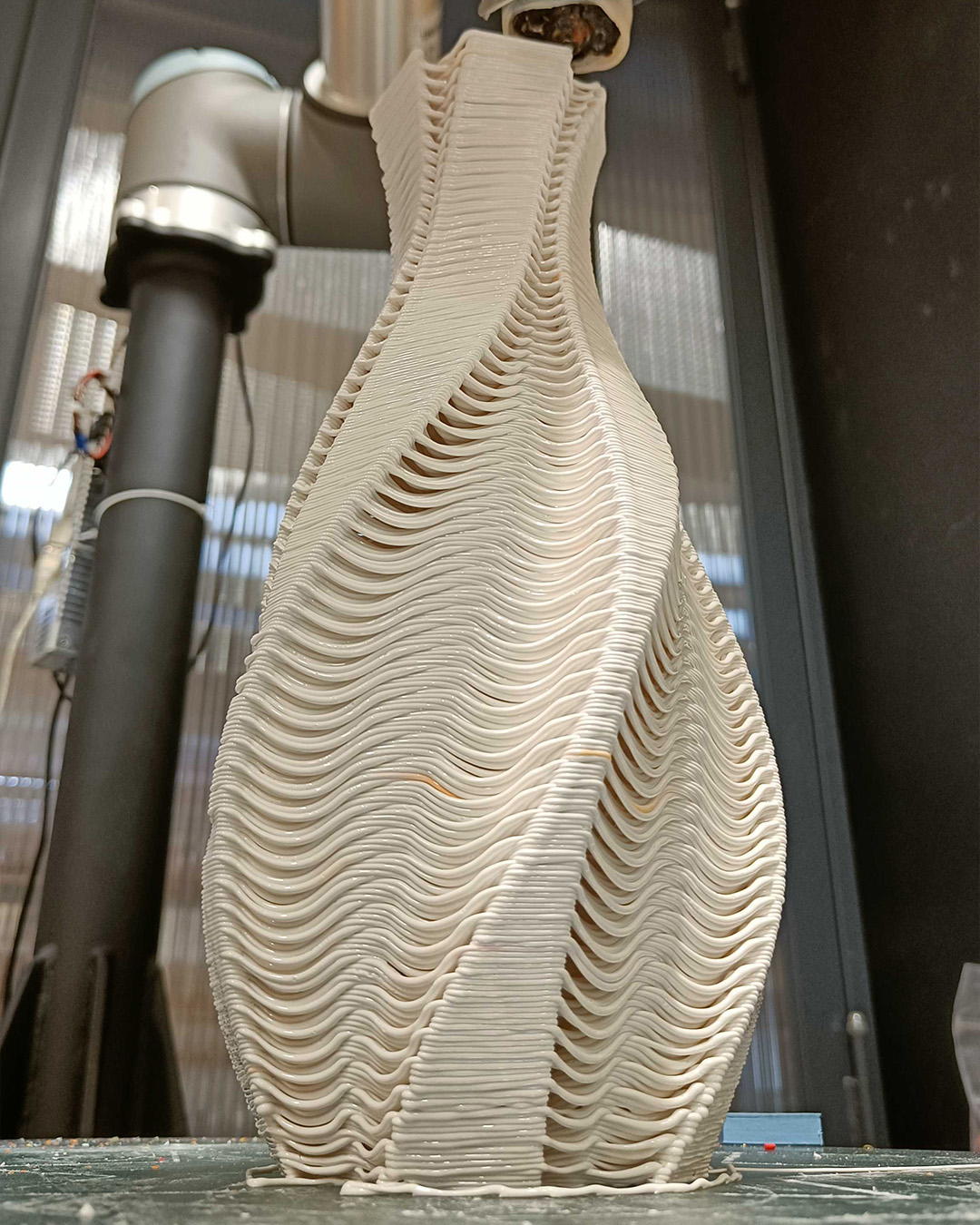
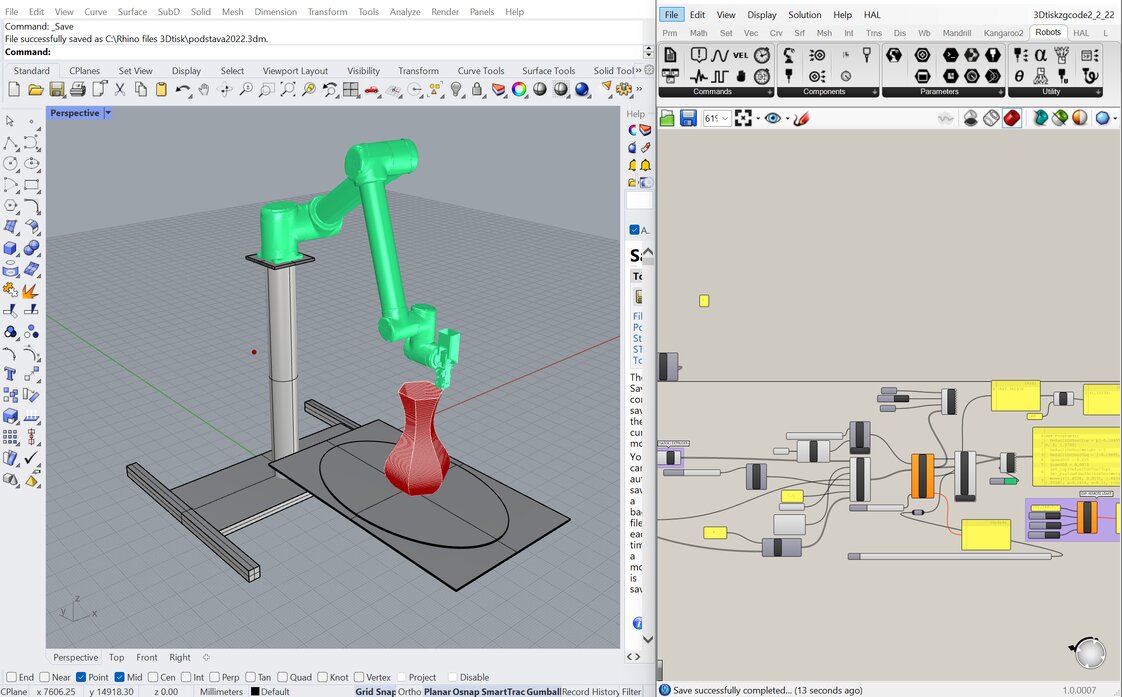
We prepared the print data in Rhino and Grasshopper and converted it into the robot's language. This let us print wavy surfaces and non-planar layers that a regular slicer doesn't allow, and test a print two metres tall.
Recycling plastic that failed quality control
Prusa Research makes Prusament filaments, from basic PLA to technical materials. Some of the material, however, doesn't pass strict quality control. Its only other use is being turned back into pellets – small plastic granules resembling tiny pebbles.
The company has its own sustainability department, which looks for ways to produce less waste and to reuse it. At PrusaLab, we asked ourselves: can such pellets be printed directly – and at large scale?
Why it couldn't be done on a regular printer
A desktop 3D printer works with 1.75 mm filament and a 0.4 mm nozzle. For large objects – vases, planters or furniture – it is slow and limited by the size of its build volume. And you can't load pellets into it at all. We needed a machine with a large working area and an extruder that could process many times more material.
A robot that first learned to draw
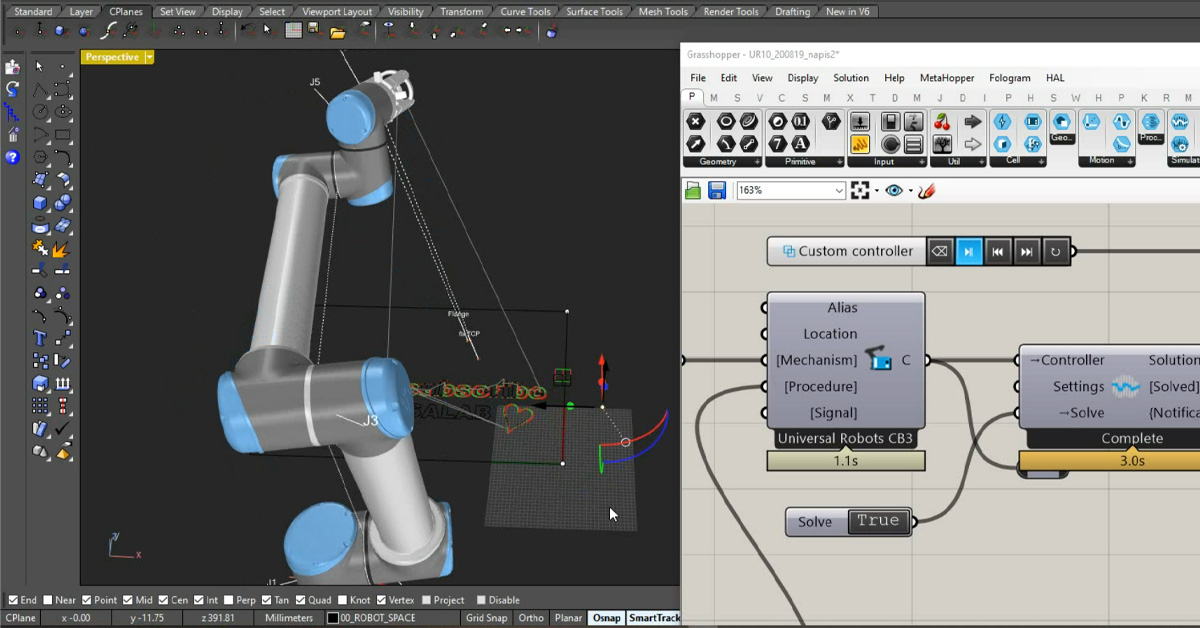
The project unofficially began when colleagues from another department gave us a damaged Universal Robots UR10 collaborative arm they no longer needed. We repaired it and, together with architect Petr Vacek , first taught it to draw on a whiteboard. This experiment showed us how a collaborative robot works, so we could then use it for 3D printing.
We fitted the arm with a pellet extruder. After researching the market, we chose the Pellet Extruder v4 from the Spanish company Mahor. We also considered solutions from Dyze Design and the open-source RichRap extruder.
How a pellet extruder works
Instead of a feed gear and a spool of filament, a pellet extruder uses a screw. Imagine a large drill bit rotating around its axis, picking up pellets from a hopper and pushing them down into the heating zone. There the plastic melts and passes through the nozzle.
Advantage: the extruder isn't limited to a single 1.75 mm filament, so it can process much more material. Pellets can be added even during printing to mix different materials or create colour gradients. We printed from PETG granulate and from ground-up PET bottles.
Disadvantage: pellets need a higher temperature to melt. We printed PETG on the pellet extruder roughly 30 °C hotter than on an Original Prusa MK3S+ printer. The print therefore needed elaborate cooling, detached from the bed more easily and warped. We cooled it with a fan on the extruder as well as externally to keep its temperature even.
Pellet extruder output: from 220 grams to half a kilogram per hour
The original extruder managed about 220 grams of material per hour. With a new motor, better cooling, better nozzles and new heating elements, we got to over half a kilogram per hour. The extruder went through so many modifications that it became unrecognisable.
We also ran into limits, though. A 2 mm nozzle is huge for desktop printers but relatively small for large-format printing – and it is the nozzle diameter that determines how much material passes through per hour.
Slicing differently: Rhino and Grasshopper
Preparing print data for a six-axis robotic arm is not the same as slicing for a regular Cartesian printer. Petr Vacek introduced us to Rhinoceros 3D and its plugin Grasshopper for parametric modelling.
We converted the commands from PrusaSlicer G-code files into coordinates that Rhino understands and, using the Visose Robots plugin, translated them into a URScript program with instructions for the individual robot axes. Later we generated and sliced the objects directly in Grasshopper.
This got us around the limits of a regular slicer and let us print wavy surfaces or non-planar layers. Non-planar printing is the biggest advantage of a robotic arm over a regular printer.
Where the experiments led
These were our first experiments with large-format 3D printing. The results: printing from recycled Prusament pellets, PETG granulate and ground-up PET bottles, extruder output increased from 220 g to more than 0.5 kg per hour, a 2-metre test print and non-planar printing thanks to data preparation in Grasshopper.
We later moved away from the robotic arm and pellet extruder setup. But we pass on our experience with parametric modelling in our Rhino and Grasshopper course. What else we have made from 3D printing waste is shown in the article Recycled plastic sheets from 3D printing waste: our experiments.
Facing a similar challenge?
Non-standard machines, experimental materials and prototypes are what we enjoy at PrusaLab. We can help with development from the first sketch through iterations to testing – get in touch. Just need a large part printed from a finished model? Large-format custom printing is provided by our sister workshop Prusa Center.



Working on something similar?
We build prototypes, test materials and combine 3D printing with electronics and engineering.
Get in touch

