


Turning waste from filament production and failed prints into something useful is a big but fascinating challenge. More than a year ago, Prusa Research set up a department responsible for the company's environmental sustainability. Even before that, we at PrusaLab had started exploring various ways to handle plastic waste smartly and efficiently. Unlike company-wide measures such as supplier analyses or life-cycle assessments of individual products, we focused on somewhat more creative solutions. After all, we are first and foremost a prototyping workshop.
One person's waste is another's treasure
Before we could start creating anything, the waste had to be turned into a material we could shape. From Plastmakersfrom North Bohemia, who were inspired by the global initiative Precious Plastic, we borrowed a shredder and started turning filaments and prints into small pellets. The original idea for using the pellets dates back to the time when PrusaLab was an open workshop visited by dozens of members and friends from the public. The plan was to build and run a community press for boards, which could then be used, for example, to make custom furniture. This plan was thwarted by the pandemic, which forced us to close and transform PrusaLab from an open workshop into a prototyping and commissioned-work studio. Without members, the idea of a plastic press was off the table and we had to keep looking.
During this search we came across Plastic Guysfrom Brno, who specialise in producing recycled plastic boards. We invited them for a visit and handed them samples of pellets made from various materials. The result was a set of colourful boards of different thicknesses that we could start experimenting with.


You can never have too many creative experiments
Machining was very difficult at first, as plastic quickly clogs cutting tools and is unsuitable for laser cutting because of the fumes released. In the end, we fine-tuned the cutting process on our router, and the first product we tried to make was a skateboard. After cutting out the deck, all we had to do was heat and bend the tail, mount the trucks and wheels underneath and apply grip tape on top. To keep the deck from cracking while riding, we also added aluminium reinforcement underneath.


The skateboard looks great and works, but since it weighs several times more than a wooden one, it certainly can't replace it. It could, however, be fitted with an electric motor and serve as an urban “getting-around” vehicle.
Our next experiment was mixing pellets into concrete. This produced a mixture from which we cast visually very interesting vessels. Their advantages, however, are purely aesthetic. These vessels are mechanically less durable than pure concrete and, as with most composites, recycling them further is very problematic, if not outright impossible.


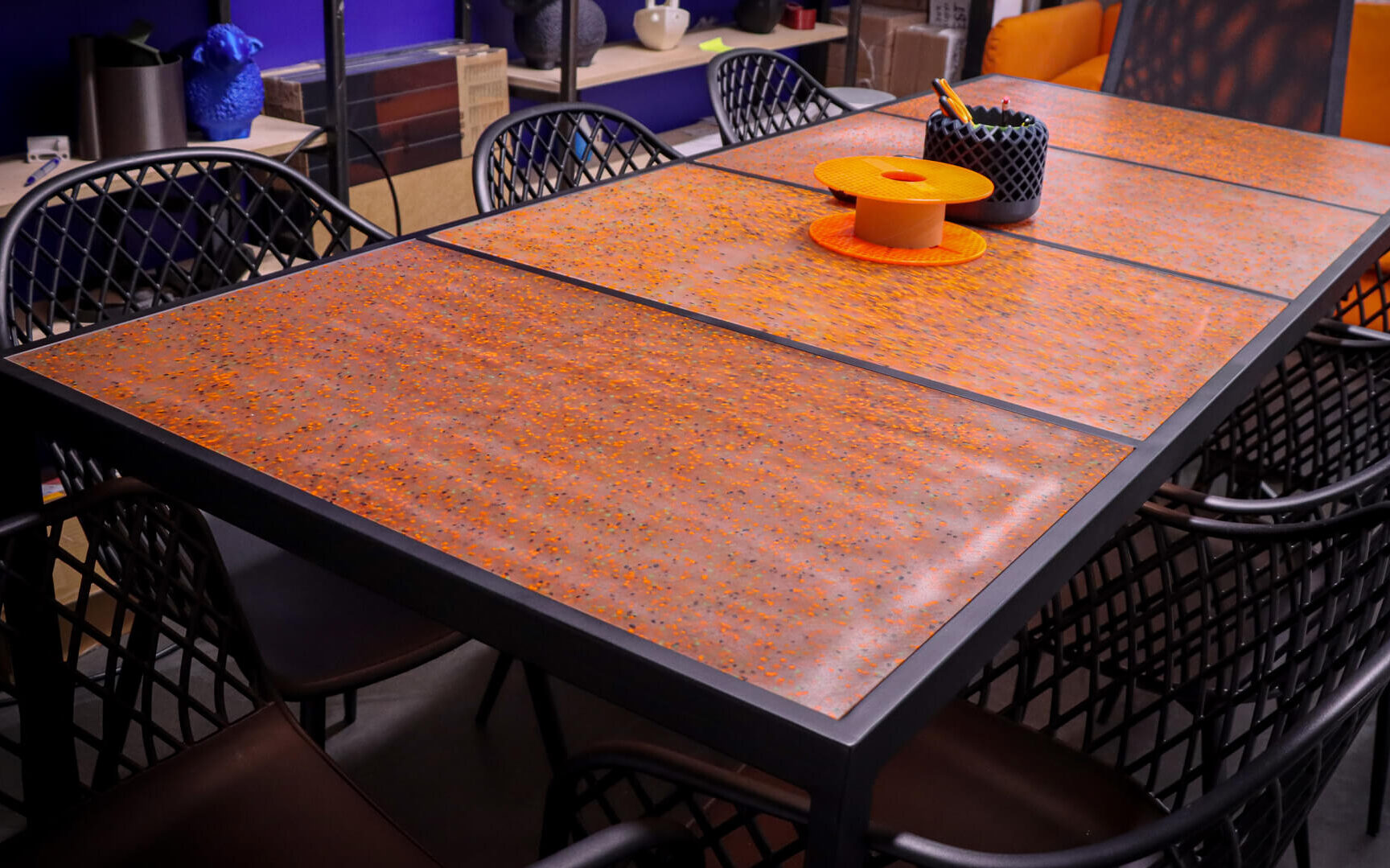
So we returned to the idea of making original furniture from pressed boards. We built one such table, with a welded steel frame and plastic boards, for the meeting room of our colleagues from the development department of Prusament. Here too, just as with the skateboard, it is worth mentioning the drawbacks of the boards as a structural element. Besides brittleness and high weight, they also require more energy to produce.
Robotic arm called into action
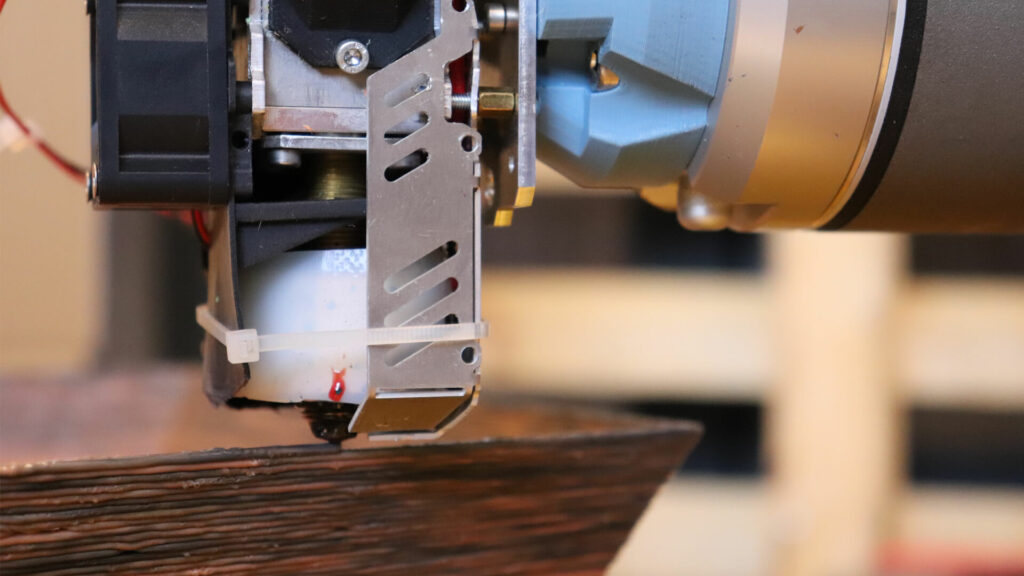
At the moment, large-format 3D printing therefore seems to us the most interesting way to process plastic waste. We are currently experimenting with various materials and exploring methods that allow printing at a large scale. We acquired a robotic arm from Universal Robots and fitted it with a pellet extruder. Since this is an experimental project, we can freely use and even modify off-the-shelf products for our needs. For example, the pellet extruder has already undergone so many modifications that it is now unrecognisable. A separate article covers this in more detail.
With a fully-fledged sustainability department now established at Prusa Research, we have the opportunity to collaborate on experiments with experienced experts and can fully focus on the hardware side of things. One of PrusaLab's missions is to test new technological processes in practice, enriching with experience not only our team and the projects we work on, but also the printing community and the rest of our company.


