- Case study
Head pointer for boccia: A custom sports aid made with 3D printing
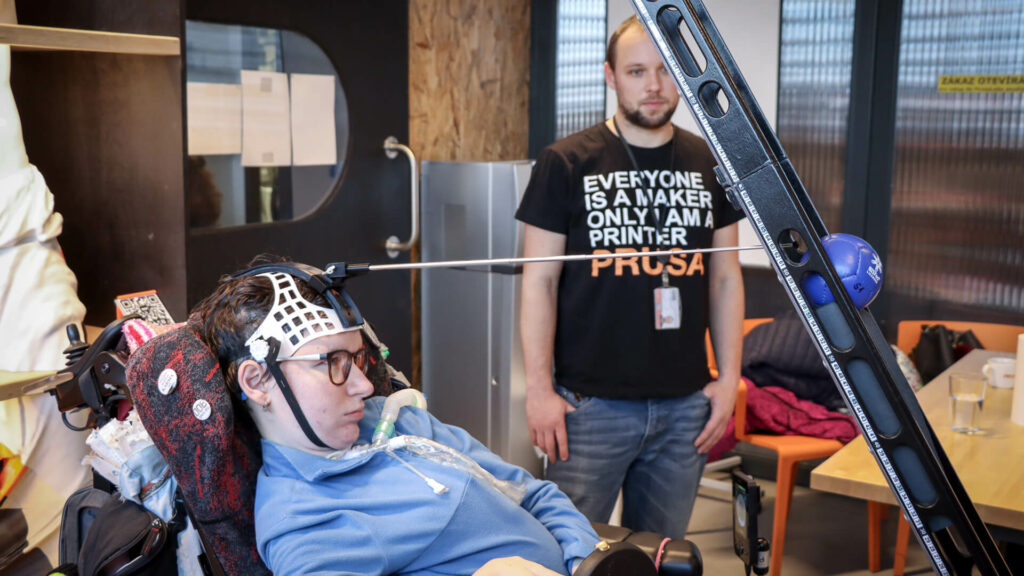
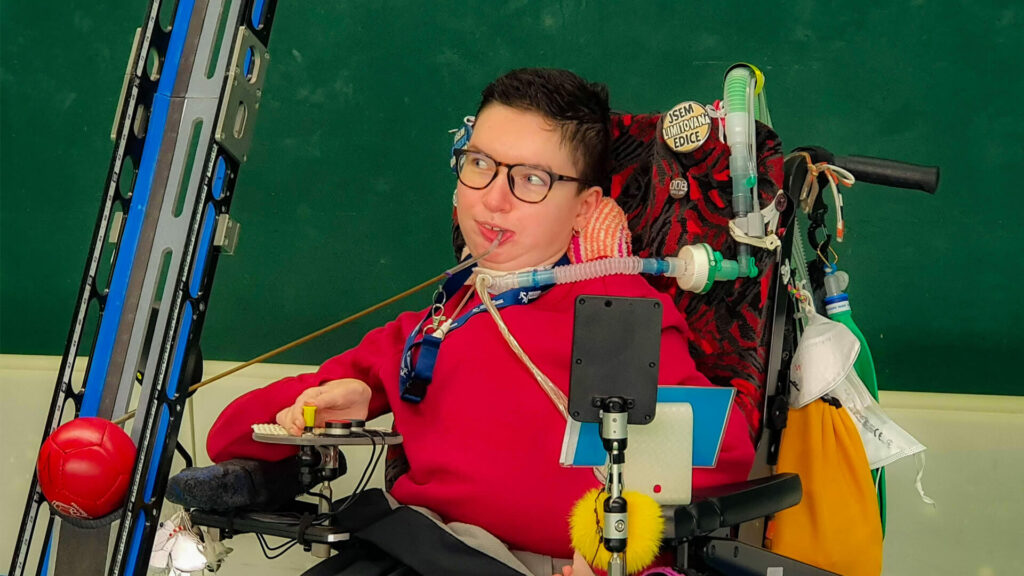
How to create an aid to help a disabled athlete achieve greater independence? In collaboration with young boccia player Anička, we designed and manufactured an individual head pointer – a lightweight mechanism attached to the head that allows her to precisely control the release of the ball from the ramp. The project shows how rapid prototyping and 3D printing can offer solutions where universal products fall short.
Customer
Private customer
Region
healthcare, sport, assistive devices
Year
2022
Result
individually designed and tested head pointer for a boccia player

A sport where millimetres matter
Boccia is a Paralympic sport designed for people with severe physical disabilities. Each player has different movement capabilities and therefore often needs custom-designed aids that are not commonly available.

A solution tailored precisely to the female player's needs
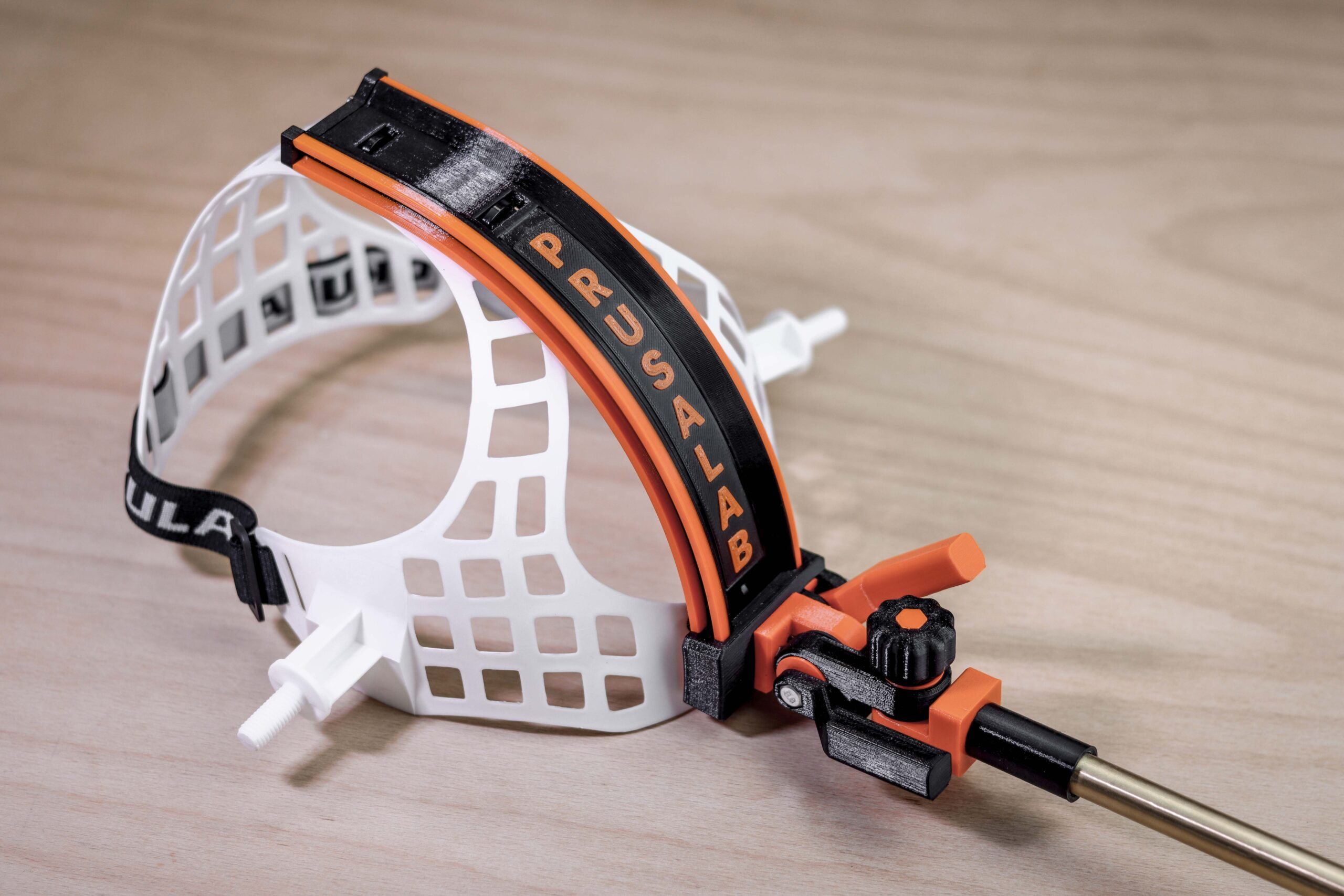
Using 3D printing, an adjustable head pointer was created, consisting of a head mount, a joint mechanism and a telescopic rod. We designed the entire system specifically according to Anička's needs and her way of playing.
Prototyping directly during testing
We modified the design several times based on feedback from real-world usage. Thanks to 3D printing, it was possible to quickly reprint individual parts, adjust their dimensions and materials, and retest them within a few days.

Technology that helps people
The project showed that digital manufacturing does not only have to serve industry. Individually designed aids can significantly increase the comfort, independence and sporting opportunities of people with disabilities.
Boccia as a sport tailored to the player's abilities
Although boccia has been a Paralympic sport since 1984, many people have still not encountered it. The principle of the game is similar to pétanque – the aim is to place your balls as close as possible to the white target ball called the jack. However, it is played on a hard surface with special leather balls, and the rules allow the way of playing to be adapted to various types of disabilities.
Anička suffers from spinal muscular atrophy and competes in the BC3 category, which is intended for players who use a special ramp to release the balls. The assistant sets the direction of the ramp and places the ball, but the actual release must be performed by the player using their own strength.
Until now, Anička had been using a simple mouth-held pointer, with which she released the ball by moving her wheelchair forward. However, this solution was not ideal in terms of comfort or accuracy. Our task was to create a system that would move the pointer from her mouth to her head and offer greater comfort as well as better adjustment options.
Development of an individual sports aid
Development began with a few consultations directly with Anička. We needed to understand not only the game mechanics itself, but above all her individual movement capabilities, range of settings, and the way she uses the aid during a match.
Originally we considered using a cycle helmet as the basic carrier. However, it soon became clear that this solution would not be suitable. Anička needs more stable head support than a standard helmet can offer.
In the end, we used an Š-P 28 type protective shield as the basis. After removing the visor, a lightweight and easily adjustable head carrier was created, which provides sufficient support and allows the secure fastening of the entire structure.
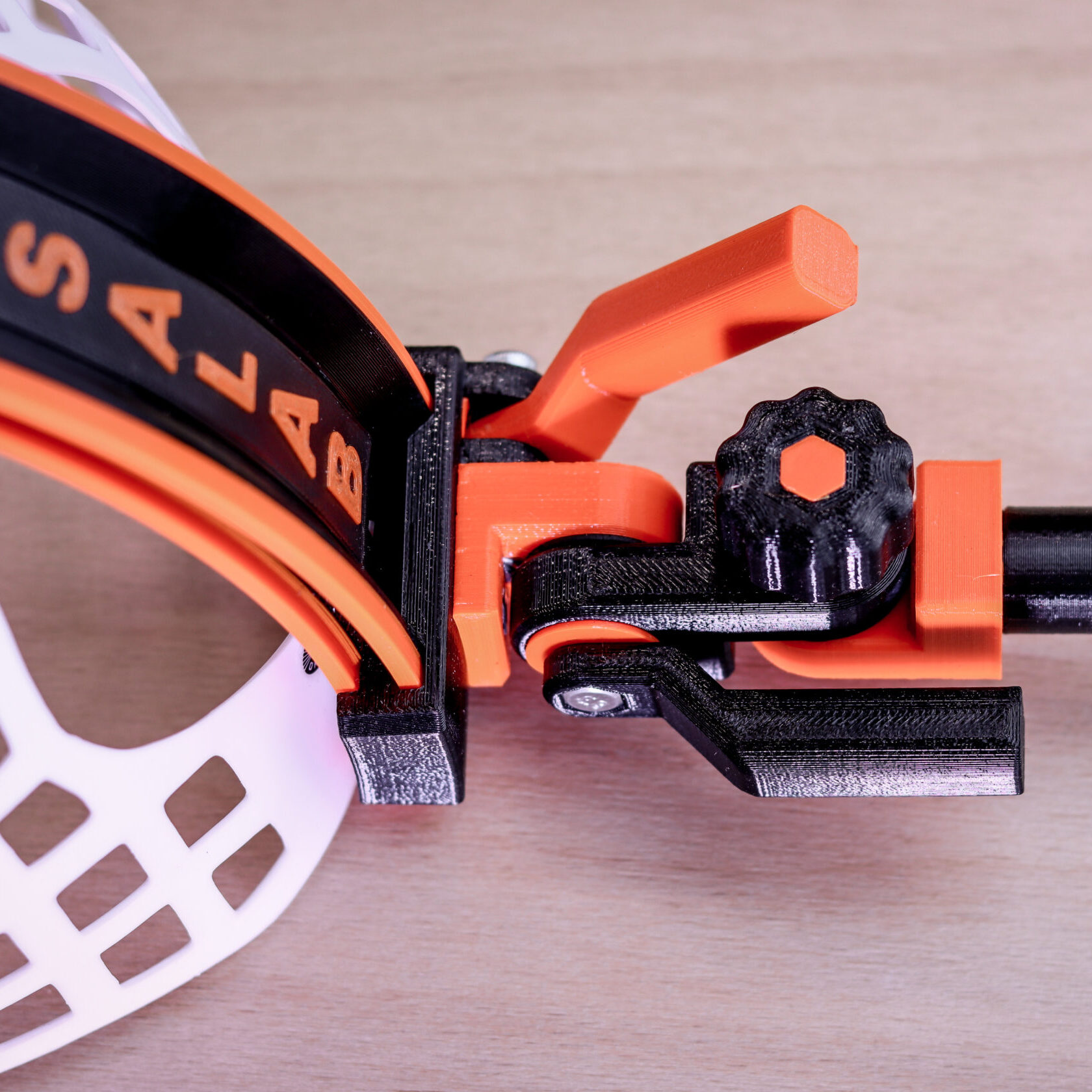
For it, we designed and 3D printed a travelling carriage equipped with two adjustable joints. These can be easily locked using screws and eccentric levers. To the structure, we attached a 124-centimetre-long telescopic pole ending in a special attachment that allows the ball to be released even over the side of the ramp.
The whole system is modular. Individual rods can be easily changed as needed, and during play, all joints can be quickly loosened, readjusted and secured again without the use of special tools.
Prototyping, testing and the right choice of materials
As with most custom aids, the final solution did not come on the first attempt. Together with Anička, we continuously tested the first prototype and modified it based on her feedback.
The biggest changes concerned the lengths of the individual parts, joint spacings, and the colour-coding of the locking levers to make operation during a match as quick and clear as possible.
The first version was almost entirely printed from Prusament PLA, which offers high rigidity. However, for the most stressed parts, we chose more durable materials. For locations with a higher risk of cracking, we used Prusament PETG, and one of the most heavily loaded pins was printed from Prusament PC Blend, which offers significantly higher mechanical resistance.
Precisely the ability to combine different materials and print a new version of a part within a few hours was one of the main advantages of the entire development.
Result
A lightweight, adjustable and easily serviceable head pointer was created, designed precisely to the needs of a single female athlete. Thanks to the modular design, individual parts can be modified at any time or simply replaced with a new print.
The project demonstrated that 3D printing can offer affordable solutions even where custom manufacturing using traditional methods would be too costly or time-consuming. Individual sports and compensatory aids are among the areas where digital manufacturing can significantly improve the quality of life and opportunities for people with disabilities.