- Art installations
Fluidum: A kinetic sculpture for Expo 2020 Dubai
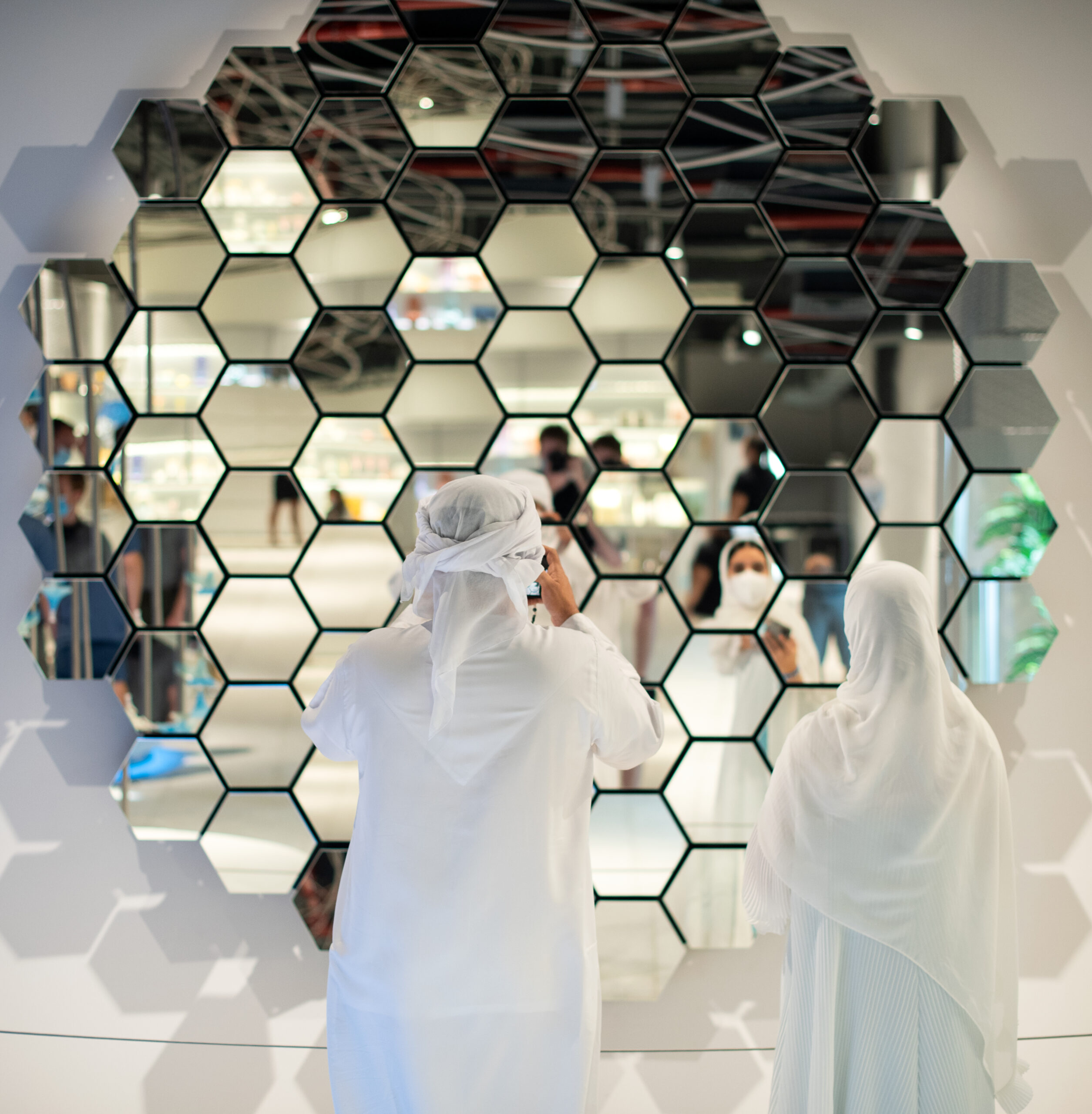
How to create a mirror that ripples like water? The kinetic installation Fluidum, designed by architect and designer Petr Vacek, combines robotics, digital manufacturing, electronics, and contemporary art. Composed of 85 robotically controlled mirrors, the piece represented Czech creativity and technological ingenuity at the Expo 2020 world exhibition in Dubai.
Customer
Czech Pavilion, Expo 2020 Dubai
Region
art, robotics, interactive installation
Year
2021
Turnaround time
4 months
The mirror that never stays the same
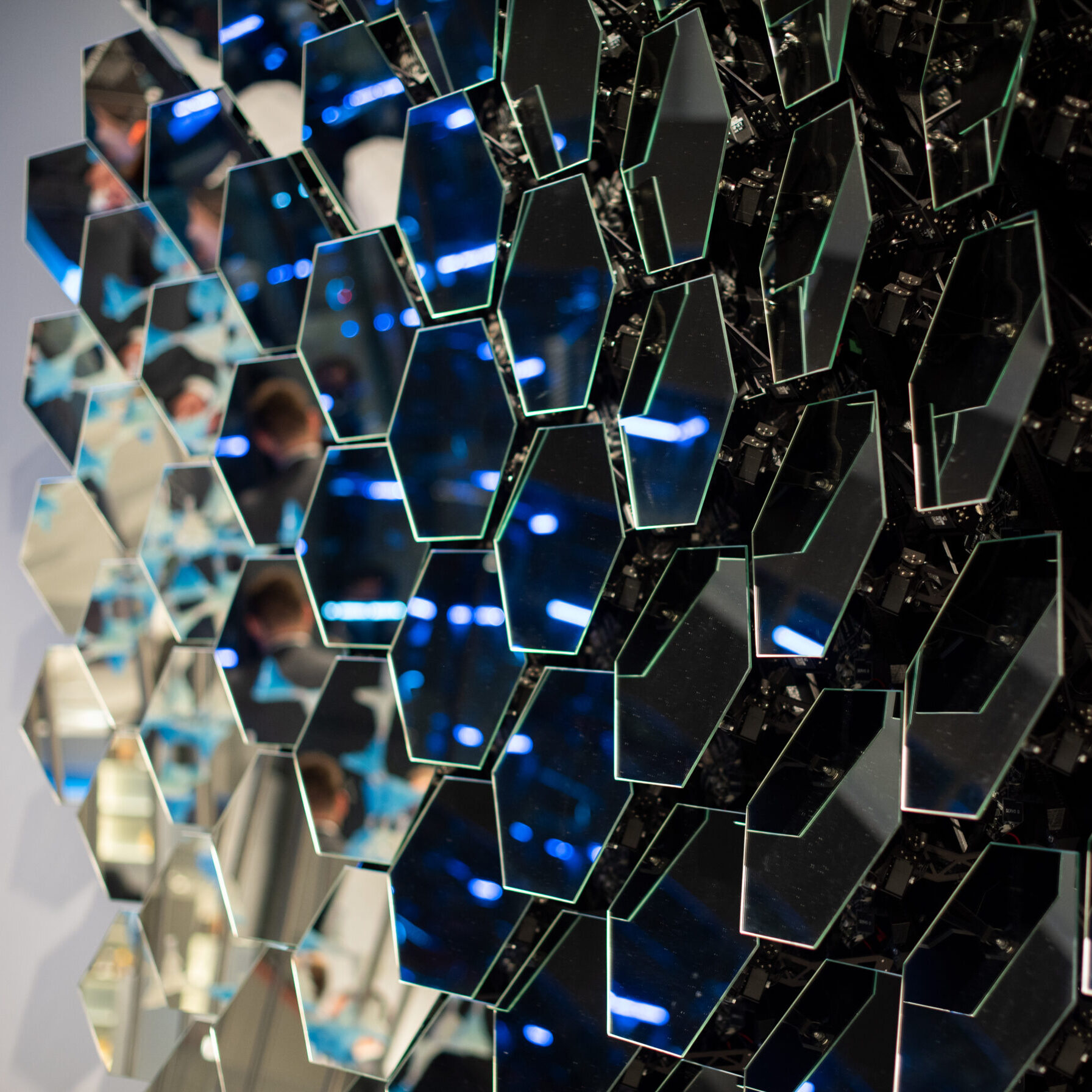
At first glance, Fluidum resembles a monumental mirrored surface. However, you only need to stop and observe it for a few seconds. The reflection begins to ripple, distort and break down into unexpected patterns. What looks like an ordinary mirror transforms into a living object responding with its own movement to the presence of the viewer.
Inspiration from the water's surface
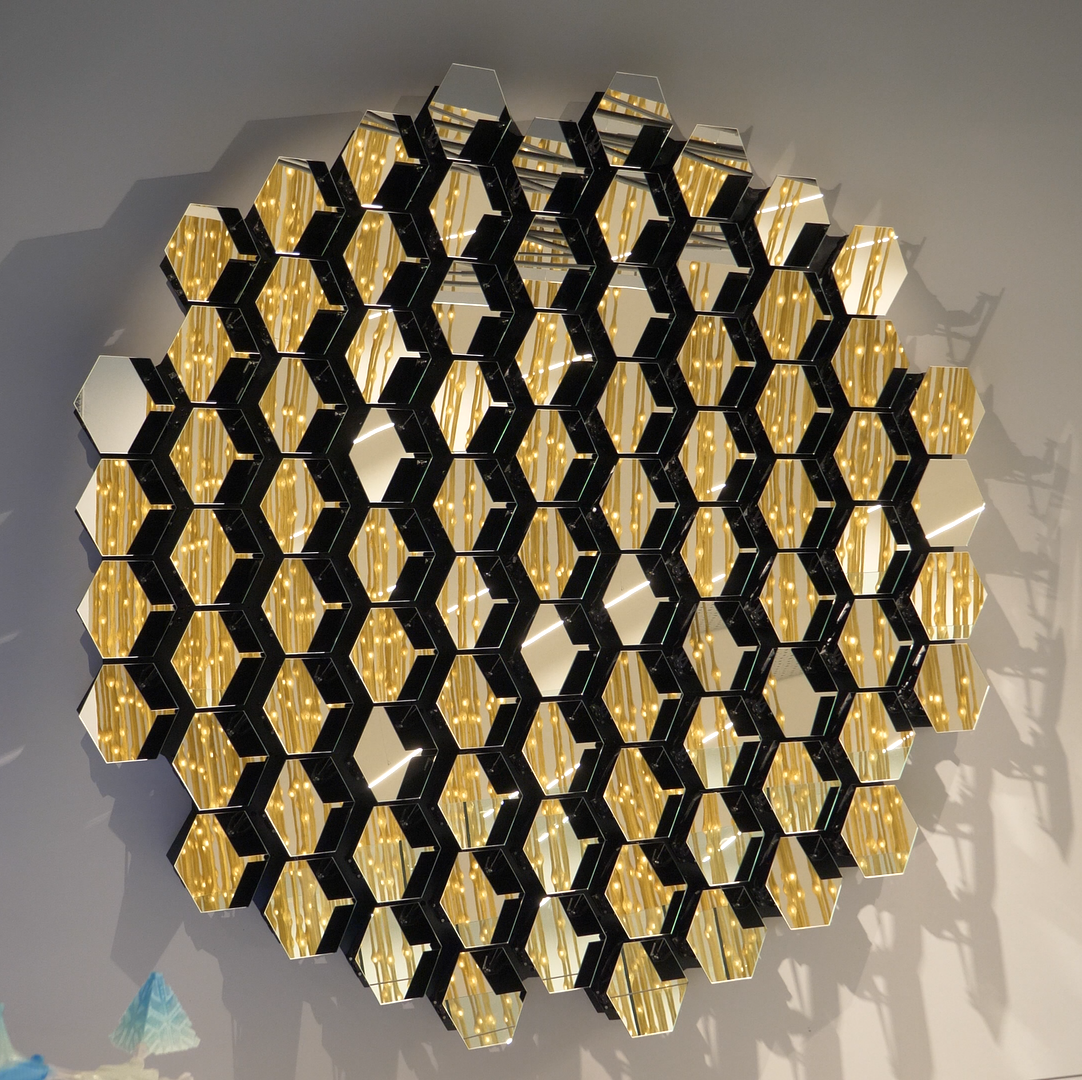
The core concept of the work is a fascination with the reflection in water. Fluidum represents a vertical water surface in which the visitor observes themselves. However, just like on a real surface, the image never remains perfectly stable. It is constantly transforming, rippling and folding into new forms.
Robotics as an artistic tool
Behind the hypnotic movement lie dozens of motors, proprietary electronics, sophisticated firmware and a unique mechanical design. However, technology here is not an end in itself. It serves as a means to create an experience that would not be possible without it.

Czech art on the global stage
Fluidum was created specially for the Czech pavilion at Expo 2020 Dubai, one of the world's most significant exhibitions. For several months, the installation represented the Czech approach to connecting design, technology and contemporary art.

From Reflexe to Fluidum
Fluidum follows on from the successful Reflexe installation, which Petr Vacek created together with Adam Cigler for Signal Festival 2019 as part of the Signal Calling programme.
While Reflexe worked with the movement of mirrors in two axes, Fluidum adds a third dimension. The individual mirrors not only tilt, but also extend towards the spectator. This creates a true spatial wave that significantly enhances the intensity of the entire experience.
The project thus represents a natural evolution of the original idea and at the same time a technological step forward.
Artistic concept
The main theme of the installation is the viewer themselves.
For his design, Petr Vacek was inspired by the idea of the first human gazing into a body of water and discovering their own reflection. Fluidum translates this archetypal experience into the contemporary technological world.
The visitor's reflection breaks up into dozens of fragments that reassemble into new images. Reality shifts, deforms and takes on new meanings. The spectator becomes part of the artwork and at the same time its main motif.
The installation thus invites you to stop and reflect in an environment that is otherwise full of constant movement and information overload.
How a single mirror works
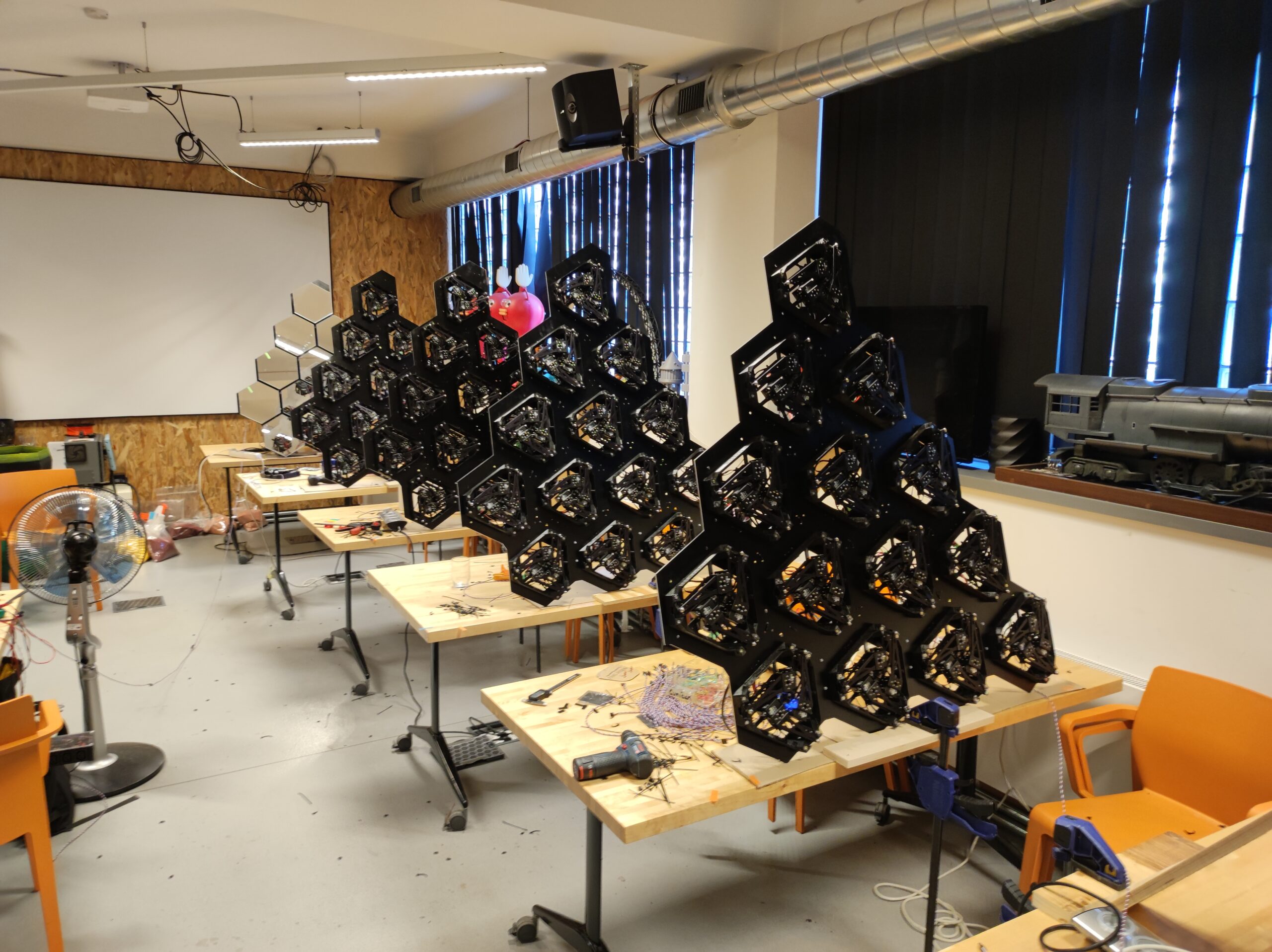
The entire installation consists of 85 independent kinetic modules.
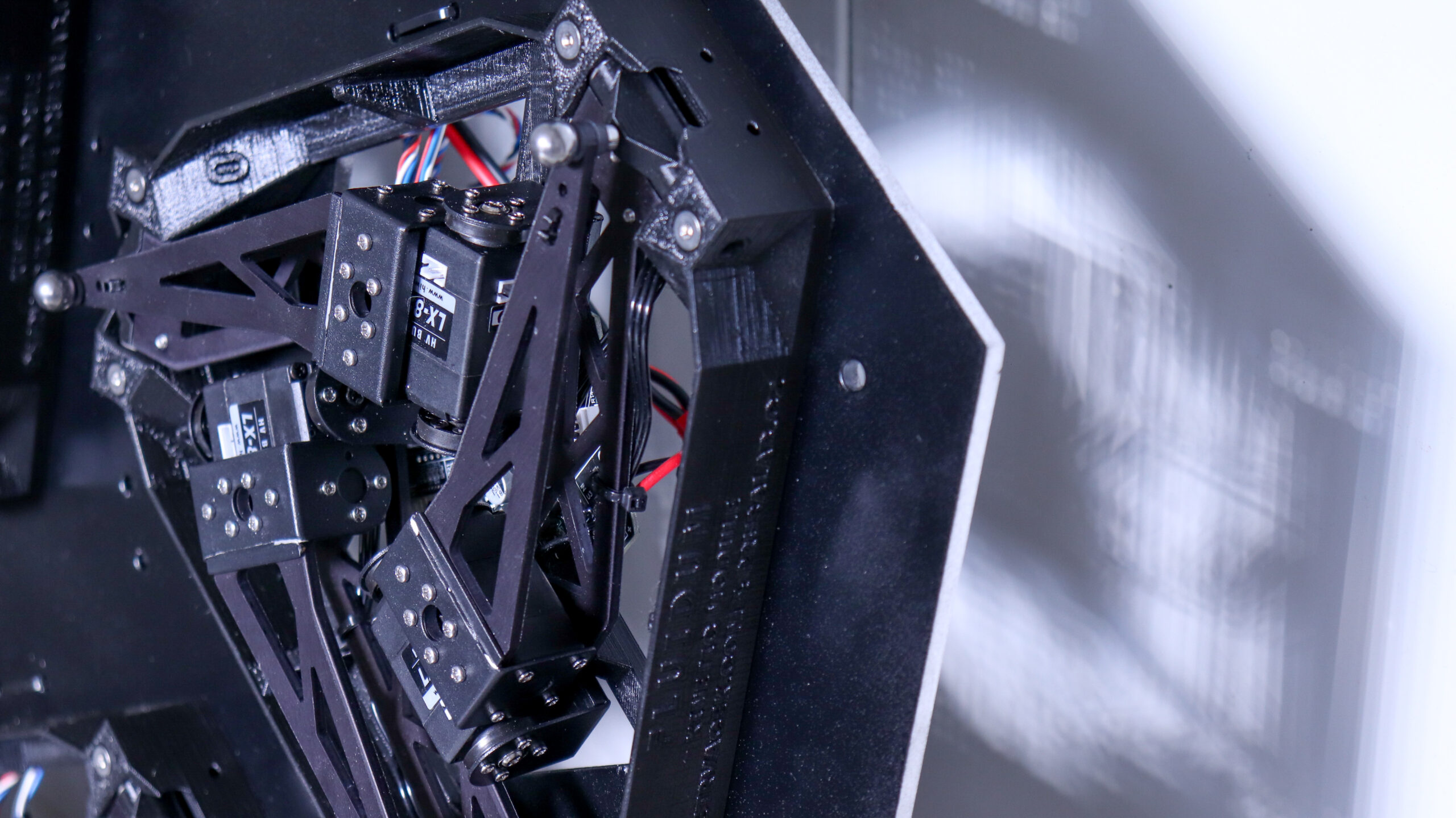
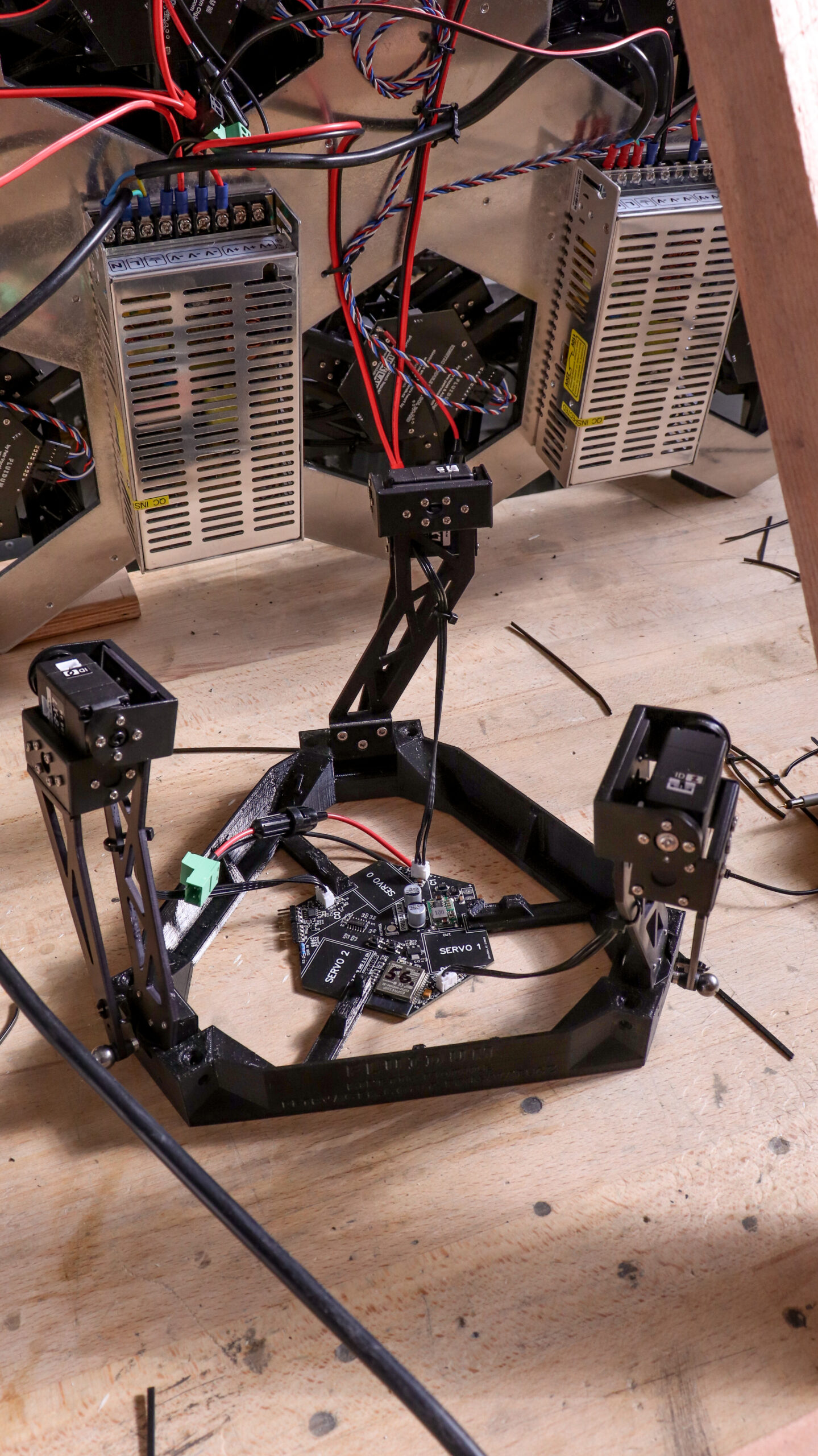
Each module contains a mirror attached to a special platform with three degrees of freedom. It can tilt sideways, forwards and backwards while simultaneously extending towards the observer.
The key to the entire solution became a modified Stewart platform. This principle makes it possible to control spatial movement by means of the coordinated movement of three motorised arms.
The same technology is used, for example, in some precise scientific equipment or in systems for adjusting optical elements.
The result is an exceptionally compact design. The entire assembly has a depth of approximately fifteen centimetres, yet it is able to extend the mirrors forward by more than another twenty centimetres.
Development under extreme time pressure
There were only four months for the complete implementation of the project.
During this time, it was necessary to design the mechanical structure, develop the electronics, create the firmware, test all functions and prepare the installation for transport to the United Arab Emirates.
Development therefore took place in the form of intensive rapid prototyping. Thanks to a 3D printing farm, new versions of parts were created virtually every day, and individual iterations were immediately tested in operation.
In addition to 3D-printed parts, it was also necessary to arrange the production of CNC-machined aluminium parts, special ball joints and other precision components.
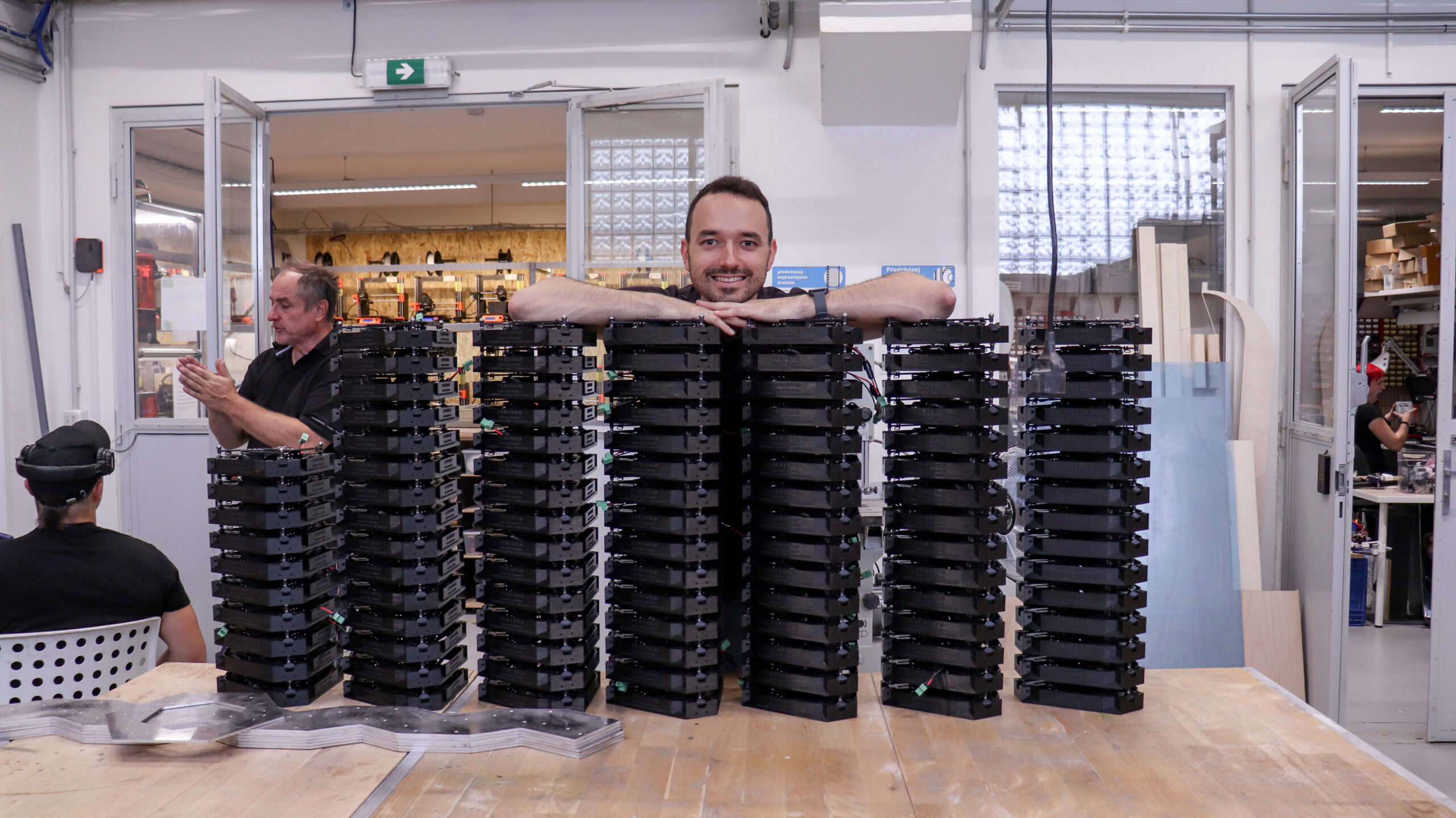
85 modules, thousands of components
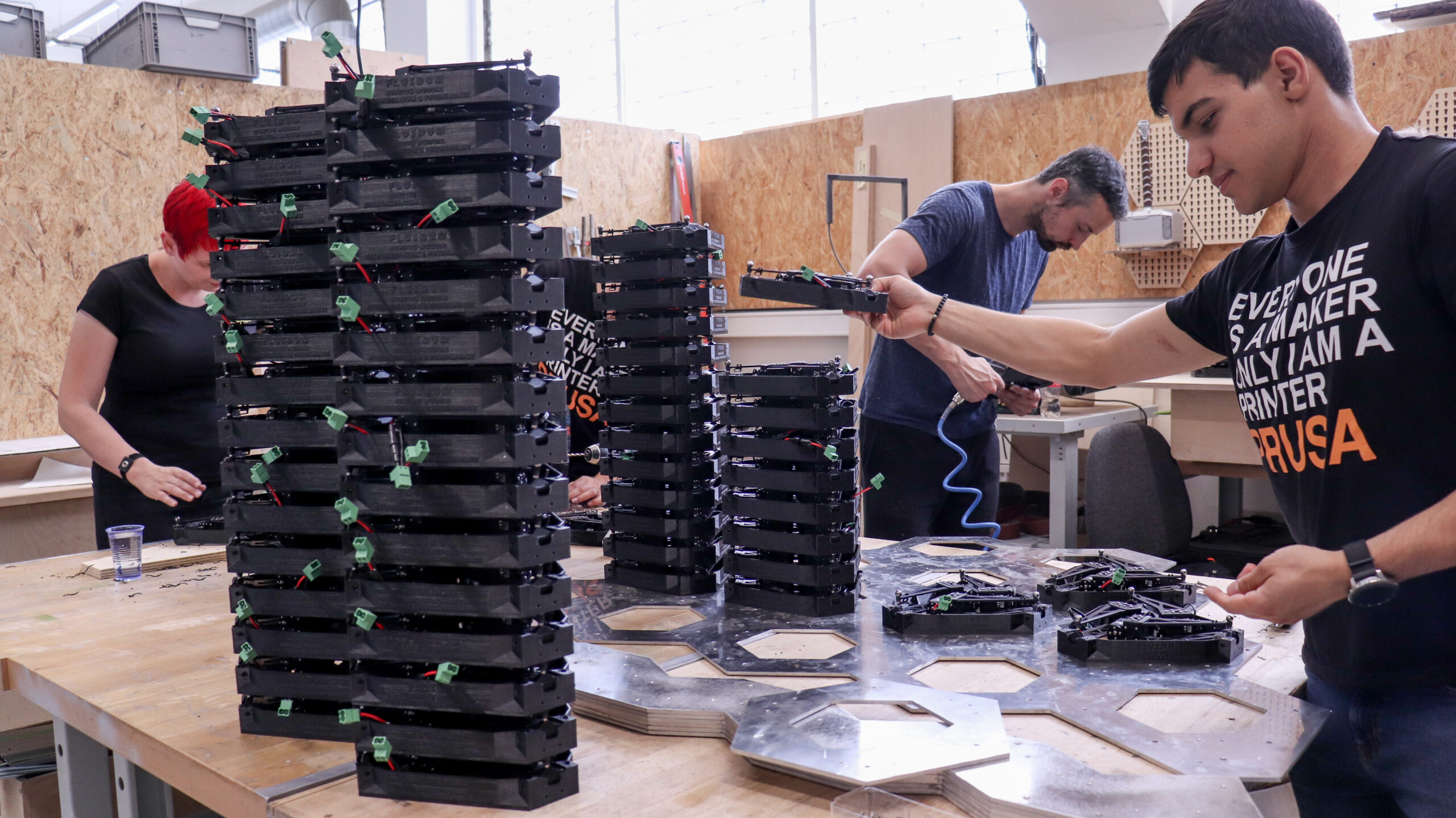
Each module consists of dozens of parts.
It features a 3D-printed chassis, a mirror platform, three laser-cut aluminium motorised arms, custom electronics and a number of mechanical joints.
Assembling a single module meant putting together more than sixty parts, tightening over a hundred screws, and fitting the electronics with a number of other components.
And all that eighty-five times.
Although production took place under considerable time pressure, we managed to complete all the modules on time and, before leaving, assemble the complete installation for the first full test.
Electronics beneath each mirror
Each module contains its own control board designed specifically for this project.
At its heart is an ESP microcomputer, which calculates kinematic equations in real-time, converting the desired mirror position into the movement of individual motors.
The used servomotors provide feedback on their position, load and temperature. Thanks to this, the system can continuously check its status and respond to any potential issues.
All modules are connected via an industrial CAN bus and communicate with a central control computer, which coordinates the movement of the entire installation.
The solution also includes custom firmware enabling bulk updates of all modules and remote management via a web interface.
Trip to Dubai
Although the installation weighs approximately 300 kilograms, it was necessary to prepare it for air transport to Dubai.
The entire system was successfully dismantled and packed onto a single standard Euro pallet. Upon arrival at the Czech pavilion, on-site assembly followed, taking place concurrently with the completion of the building itself.
The final days before the exhibition opened were devoted to fine-tuning the software, programming the safety features and creating the final choreography for the movement of the mirrors.
When the spectator becomes part of the work
Unlike many contemporary interactive installations, Fluidum does not contain sensors that track visitors.
Yet people spontaneously wave, move, take photographs and try to establish contact with the sculpture. This is because they instinctively assume it is reacting to their presence.
In fact, the movement of the mirrors is pre-programmed.
It is precisely this paradox that turns the visitor into an unexpected actor in the entire situation. Not interactive technology reacting to a human, but a human reacting to technology.
Result
Fluidum operated in the Czech pavilion seven days a week, twelve hours a day for the entire duration of the Expo 2020 Dubai world exhibition.
The installation attracted thousands of visitors from around the world and became one of the most prominent exhibits of the Czech exposition. The combination of robotics, digital manufacturing, architecture and art created a work here that functions just as well as a technological demonstration as it does a powerful emotional experience.
For PrusaLab, Fluidum represents one of the most complex projects we have been involved in. It is proof that modern manufacturing technologies can serve not only industry, but also the creation of new forms of contemporary art.