


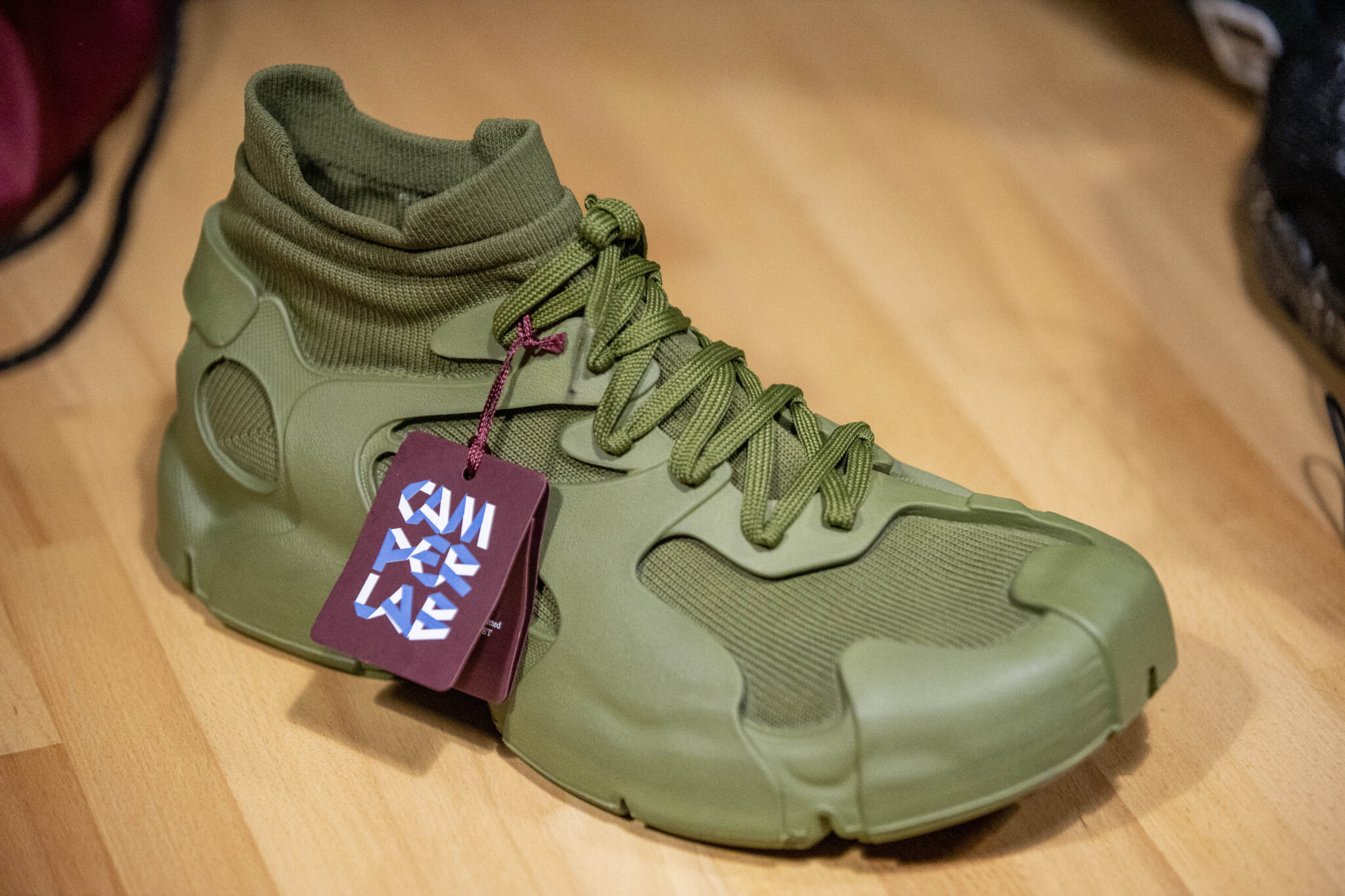
At Meet the Makers 20 we had the chance to hear a presentation by Eliška Horčíková, a footwear designer at Camper. Eliška shared her story, which shows how 3D printing can develop and advance a traditional craft, especially its design side.
The video recording is in Czech.An innovation team
Eliška started at the company ten years ago as an intern, gradually worked her way up and now helps define the next generation of Camper products. Camper was looking for an innovative approach that would meet modern needs while respecting tradition. While working on new models, Eliška realised that some projects needed more time and development, which led to the creation of a small innovation team focused on new technologies and manufacturing processes.
Roku – modularity and sustainability
Eliška presented several innovative projects her team had worked on. The first was the “Roku” shoe – a modular shoe made of six parts that are not glued together. This minimalist design was created with an emphasis on sustainability. The shoe is made from recycled materials and designed to be easy to repair and recycle again. The parts fit into one another, and the wearer’s weight helps hold the components together.
Thanks to 3D printing, Eliška and her team could test different versions of the sole, which had to be sufficiently strong, flexible and adaptable. This process made it possible to create prototypes faster and more efficiently, without having to invest in expensive metal moulds.
Tosu – a new polyurethane injection technology
Another project was a shoe called “Tosu”, created in collaboration with a technology startup in Spain. It is the only company using a new polyurethane injection technology that can cover the whole shoe, not just the sole. Here too, 3D printing played a key role in developing prototypes and fine-tuning the design before production started.
Eliška also mentioned other innovations designed with sustainability and easy repair in mind. Another example is the “Junction” shoe, designed so that the upper can easily be separated from the sole and recycled or repaired. This project was also based on the principle of minimalism and simplicity in design, with an emphasis on extending the product’s life.
Challenges and the future of 3D printing in footwear
One of the main topics of the presentation was the challenges of introducing 3D printing in the footwear industry. Although 3D printing allows faster prototyping and testing, there are still obstacles, such as high costs and long production times for larger series. Eliška said they are currently exploring how the whole sole or part of it could be 3D printed, but for now the process is too expensive for mass production.
Even so, 3D printing remains a promising path in footwear, especially for personalisation and made-to-measure production, for example in orthopaedics, where shoe components are made for customers with unique needs.
Conclusion
Eliška Horčíková’s presentation showed how tradition can be combined with innovation to push the boundaries of the footwear craft. Thanks to modern technologies such as 3D printing, the footwear industry can place greater emphasis on recycling, repairability and personalised products. Eliška inspired us with her approach to design and showed that there is still room in footwear for innovation and new paths.
Want to see all the videos from Meet the Makers 20? 👉 Click here! 👈


